Secondary RSHE

High quality RSHE is:
Protective – it safeguards children in today’s digital era. It helps them to understand healthy relationships and consent, recognise abuse and ask for help; and reduces gender-based violence.
Developmentally appropriate and responsive – sequenced to prepare children and young people as they move through puberty, adolescence and into adulthood. It is responsive to the questions children ask, and to current and emerging issues.
Inclusive – it celebrates diversity and is relevant to all students, including those who are disabled and neurodivergent, LGBT+, and from a range of cultural and faith backgrounds.
Evidence-based – informed by research and by children and young people’s experiences, and delivers scientifically accurate information from reliable sources.
Empowering – celebrating healthy relationships, not just addressing risk and harm. It engages with boys and young men, and helps young people to aspire to relationships that are supportive, caring and pleasurable.
Effective - alongside developing essential knowledge, it facilitates open discussion and plays a vital role in helping children develop crucial life skills.
Professional - taught by trained, well supported teachers and specialists
Engaged with parents and carers who are informed about the development of the curriculum, and consulted to ensure RSE meets the needs of families
RSHE Pledge:
Protective – keeping children and young people safe in today’s digital era
Developmentally appropriate - and responsive to the questions children ask, and to current and emerging issues
Empowering – celebrating healthy relationships, not just addressing risk and harm
Inclusive – relevant to all students and reflective of the whole community
Evidence-based – informed by research and by children and young people’s experiences
Effective – focusing on life skills and open discussion as well as factual knowledge
Taught by trained teachers and supported by specialists
Engaged with parents and carers to ensure RSE meets the needs of families
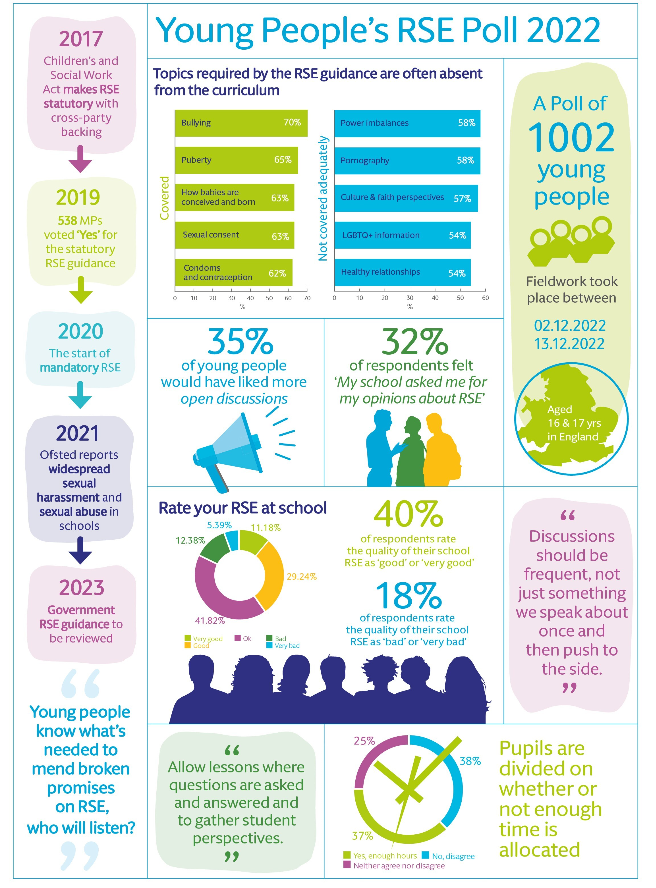
Young People's RSE Poll 2022
A survey of 1,002 young people aged 16-17 in England carried out by Census wide between 2 and 13 December 2022, and commissioned by the Sex Education Forum, reveals broken promises in relationships and sex education, which leave young people unprepared for modern challenges.
- Three years after the Government introduced statutory RSE, only 40% of young people rate their lessons as ‘good’ or ‘very good’. Meanwhile, nearly one in five (18%) still say their in-school RSE is bad or very bad.
- Students report that they don’t learn enough about today’s most pressing issues, including pornography (58%), LGBTQ+-relevant information (54%), and healthy relationships (54%).
- While 44% of respondents agreed that what they learned in RSE had helped them and 42% said the content felt relevant to them, over a quarter still felt lessons were neither relevant (26%) nor helpful (27%).
Reported quality of RSE improved since last year, up five percentage points in 2022 from just over a third (35%) of students saying RSE was ‘good’ or ‘very good’ in 2021. However, this number remains level with 2019 poll data collected before RSE became statutory – showing how much work is yet to be done in ensuring all students have access to quality curricula.
The research underscores the importance of the Sex Education Forum’s calls for young people to be listened to and engaged in RSE curriculum development, and increased Government investment in teacher training, to ensure every young person can access quality, meaningful RSE.
Young People's RSE Poll 2022 Report
Download the poster here
Ofsted Personal Development Framework
As of 2019, Relationships Education, Relationships Sex Education (RSE) and Health Education form a part of the personal development framework.
Education Inspection Framework
Talk Relationships supports secondary schools to confidently deliver inclusive sex and relationships education.
We want all young people to understand healthy behaviours in relationships and recognise their right to be safe, heard and respected. And we want them to know how to get help from a trusted adult if they need it.
Delivering sex and relationships education training
Online training to support secondary school teachers and leaders to deliver inclusive sex and relationships education
Our CPD-certified elearning courses for teachers and leaders feature a mix of reflective tasks and video-based content that share insight from teachers, young people, and safeguarding experts to help develop your school deliver effective and inclusive sex and relationships education.
The teachers' course will help improve teaching staff's confidence in delivering these messages and lessons. And the school leaders' course supports leadership teams to take a whole school approach to sex and relationships education.
This training, along with a series of lessons plans and a dedicated helpline, is part of our Talk Relationships service. Talk Relationships supports people working in secondary education to overcome any challenges they may face when delivering sex and relationships education.
These courses are free to take for a limited time.
> Access now
Message for PSHE/ RSHE leads
GHLL (gloucestershire Healthy Living and Learning) has a team of specialised lead teachers covering Key Stage 3, 4 and 5. They can assist you in evaluating and developing your PSHE curriculum. This is available to all educational settings across the county free of charge.
Contact us at GHLL@gloucestershire.gov.uk
How To Tackle Tough Questions from Secondary School Students in Sex and Relationships Education
Jigsaw Education Group have put together a really helpful resource which can be access here:
How To Tackle Tough Questions from Secondary School Students in Sex and Relationships Education
RSHE expert advisory group announced
Announcement from the Sex Education forum - 29th September 2026
Over the weekend, the Secretary of State for Education, Lucy Powell, announced new measures on RSHE and a whole-school approach to tackle misogyny. The statement, issued on 26 September, says:
"Schools will be supported with a practical framework to tackle misogyny with resources including practical guides, teacher training and parent support.
The new approach will help to create a culture of respect and belonging, and embed positive attitudes from classroom teaching and enrichment activities to pastoral support and interactions beyond the school gates."
And continues:
" To support teachers with the new [RSHE] curriculum, the government is investing £150,000 in a new RSHE expert advisory group. Bringing together expert organisations and practitioners, the group will develop new resources to support teachers delivering sensitive and complex topics confidently. "
Whilst we are yet to learn further details about these plans, Sex Education Forum welcomes this announcement. It makes perfect sense for a range of experts in RSHE to work closely with Government to support implementation of the updated guidance. We and others have been calling for the formation of a group that we hope will enable regular dialogue and action to support schools with their immediate RSHE needs and a longer term plan for sustained improvement.
It is unclear if any new funding is being committed to training and support for schools with RSHE. The full announcement is available from Gov.uk website
Sexual Health Week 2026
Brook's latest Big RSE Lesson is available to watch on demand. This year we teamed up with Movember for a 60-minute lesson looking at what it means to connect with friends, partners, and ourselves. The lesson is aimed at year 9 and above and is completely free to watch online.
- Explore what makes friendships and social connections – on and offline – good for our health and wellbeing
- Identify the characteristics of healthy relationships, including trust, respect, equality and consent
- Understand that physical touch, affection and intimacy are all valuable aspects of human connection – whether sexual or not
- Discover why intimacy is about connection, not performance — and what that means for consent, communication and confidence
- Know where to go for trusted advice, support, and information about relationships and sexual health
Brook and Movember’s BIG RSE Lesson: Let’s Connect – Learn Live
Contraception Methods : How they work
Brook Charity have 12 free vidoes available explaining the differnt methods of contraception available in the UK.
Access the short animations of how the different methods of contraception work throuigh the links below:
Vaginal ring contraceptive method: How does it work to prevent pregnancy?
Fertility awareness or 'natural family planning': How does it work?
Hormonal and copper coils: How do they work?
Sterilisation: How does it work?
Diaphragms & caps: How do they work?
Contraceptive Implant: How does it work?
Contraceptive Injection: How does it work?
Contraceptive patch: How does it work?
The progestogen-only pill (POP) or 'mini pill': How does it work?
Combined pill or 'the pill': How does it work?
Condoms: How do they work?
Emergency Contraception: The "morning after pill" and copper coil. How do they work?


