Social Prescribing
Gloucestershire Healthy Living and Learning (GHLL) provides links to trusted information and resources on a wide range of topics such as this page for social prescribing. Please note that we are signposting to external sources and are not a social prescribing directory or referral service.
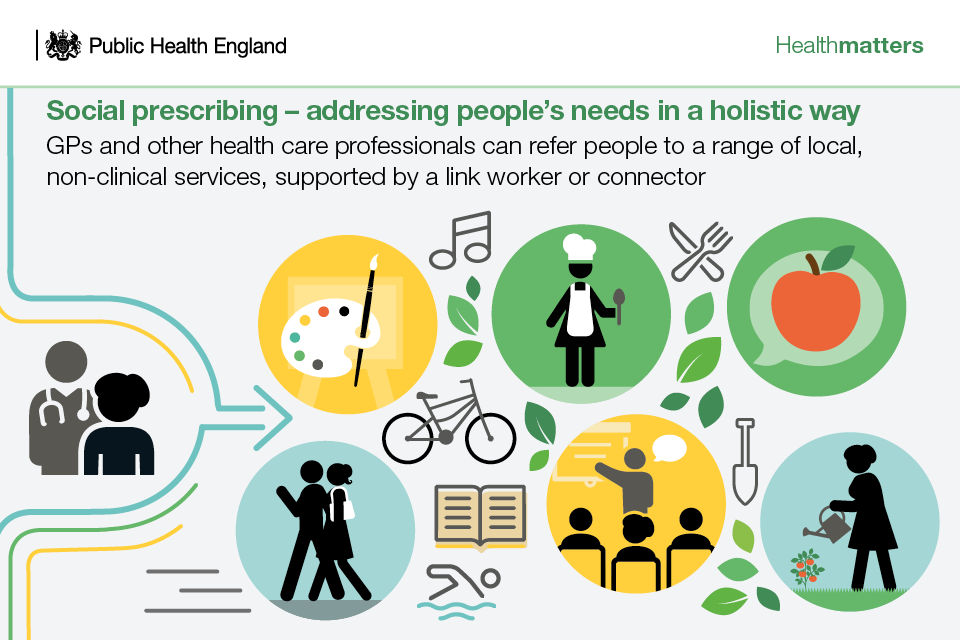
Social prescribing is a key component of Universal Personalised Care.
Social prescribing is a way for local agencies to refer people to a link worker. Link workers give people time, focusing on ‘what matters to me’ and taking a holistic approach to people’s health and wellbeing. They connect people to community groups and statutory services for practical and emotional support.
Link workers also support existing community groups to be accessible and sustainable, and help people to start new groups, working collaboratively with all local partners.
Social prescribing works for a wide range of people, including people:
- With one or more long-term conditions
- Who need support with their mental health
- Who are lonely or isolated
- Who have complex social needs which affect their wellbeing.
When social prescribing works well, people can be easily referred to link workers from a wide range of local agencies, including general practice, pharmacies, multi-disciplinary teams, hospital discharge teams, allied health professionals, fire service, police, job centres, social care services, housing associations and voluntary, community and social enterprise (VCSE) organisations. Self-referral is also encouraged.
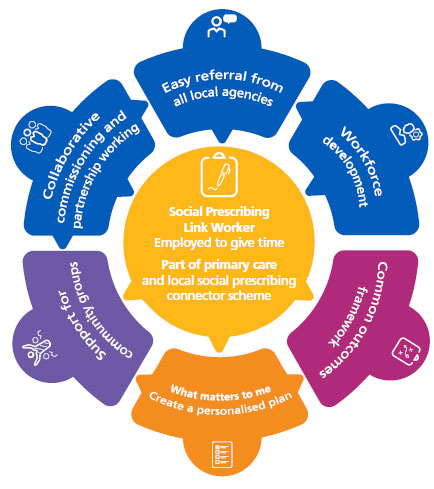
A standard model of social prescribing has been developed in partnership with stakeholders, which shows the key elements that need to be in place for effective social prescribing;
Social prescribing complements other approaches, such as active signposting. This is a ‘light touch’ approach where existing staff in local agencies provide information to signpost people to services, using local knowledge and resource directories. Active signposting works best for people who are confident and skilled enough to find their own way to services after a brief intervention.
Social Prescribing Link Workers
In the Long Term Plan NHS England committed to building the infrastructure for social prescribing in primary care:
- There will be 1,000 new social prescribing link workers in place by 2020/21, with significantly more after that, so that
- At least 900,000 people will be referred to social prescribing by 2023/24.
This is part of the drive to Universal Personalised Care that will see at least 2.5 million people benefiting from personalised care by 23/24.
Social prescribing link workers are becoming an integral part of the multi-disciplinary teams in primary care networks (PCNs). They are part of the additional roles in the five year framework for GP contract reform and are included in the Network Direct Enhanced Service Contract for 2020/21.
This is the biggest investment in social prescribing by any national health system, and legitimises community-based activities and support alongside medical treatment as part of personalised care.
Case Studies
Impact
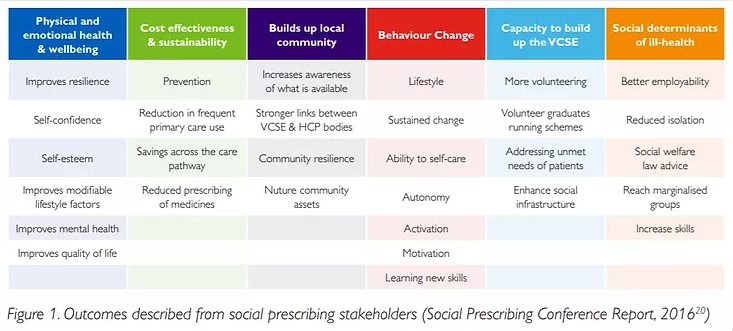
There is emerging evidence that social prescribing can lead to a range of positive health and wellbeing outcomes for people, such as improved quality of life and emotional wellbeing.
Though there is a need for more robust and systematic evidence on the effectiveness of social prescribing, social prescribing schemes may lead to a reduction in the use of NHS services, including GP attendance. 59% of GPs think social prescribing can help reduce their workload.
Arts on Prescription in Gloucestershire
Cinderford Artspace, Art Shape and The Music Works accept referrals for arts on prescription. The sessions are available to children and young people with long term health conditions. All programmes offer 1:1 or small group sessions and are bespoke to the young person’s likes and wants.
Cinderford Artspace offers circus & aerial skills, and pottery.
Art Shape provides a range of arts & creative activities including visual arts, animation, and photography.
The Music Works facilitate song-writing, learning an instrument, singing, rapping, music tech & developing computer game soundtracks.
The outcomes and targets of arts on prescription are to:
Referral Form - Arts on Prescription (Word doc)
Referral Form - Arts on Prescription (PDF)

Short breaks
What are Short Breaks? ‘
Short Breaks’ provide specialist activities, care and support to families of disabled children and young people so that: • unpaid carers receive breaks from their caring responsibilities to maintain their resilience, and their physical and emotional wellbeing • disabled children and young people have opportunities to socialise independently in an environment that is safe, secure and suitable for their needs.
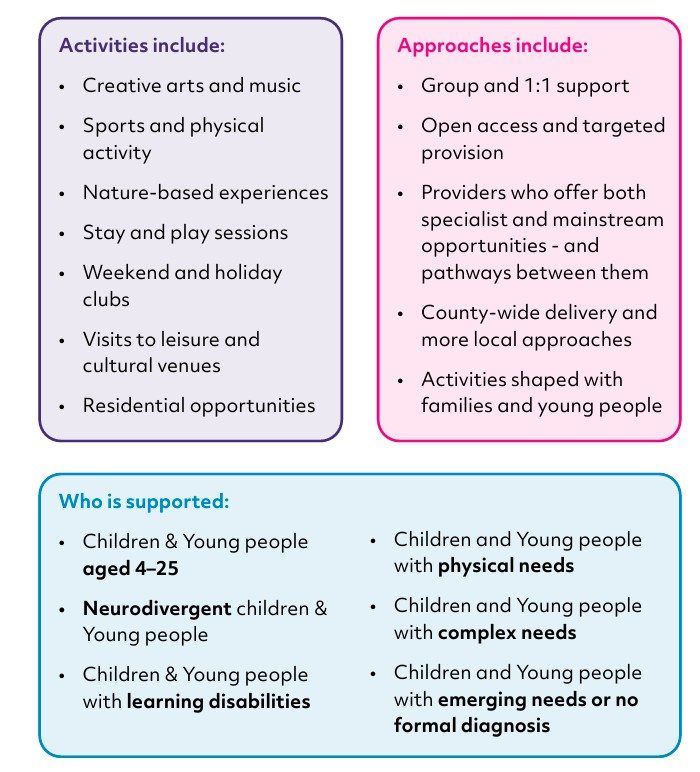
In 2022, Barnwood Trust completed its Barriers to Short Breaks2 research, capturing the experiences of parent-carers, disabled young people and Short Breaks providers in Gloucestershire. In 2023, a co-design group involving disabled young people and parent-carers, alongside members of the Barnwood team, drafted a brief for the Short Breaks Fund. This brief prioritised co-design, widening access, choice, voice, and innovation to test ways of overcoming the barriers highlighted in the research.
The same group joined a panel to recommend which organisations should receive the Short Breaks Fund. Consequently, 6 organisations were awarded up to £70,000 each to deliver ‘test and learn’ projects across Gloucestershire for one year. This report summarises the impact and learning gathered from this year-long programme as well as the implications it has had on provision, practice, and commissioning in the county.
Year one pilot: https://www.barnwoodtrust.org/wp-content/uploads/2025/05/Short-Breaks-Year-One-Impact-and-Learning-Report.pdf (this was done without GCC)
Year one of partnership: https://www.barnwoodtrust.org/wp-content/uploads/2026/06/Short-Breaks-Test-and-Learn-Fund-Report-25-26.pdf
he partnership ends in 2027 when the new ShaRe Framework comes into effect.
In addition to these four new funding awards, Barnwood Trust is pleased to announce an extension of funding until April 2027 for the six original organisations that participated in the Short Breaks Change Programme. These organisations have already demonstrated a strong commitment to delivering high-quality, inclusive services across Gloucestershire and we look forward to continuing to work with them as they build on their learnings and success.
Barnwood Trust, Gloucestershire County Council and Gloucestershire VCSE Alliance have awarded four organisations two years of funding through our partnership to enhance Short Breaks provision in Gloucester, Tewkesbury, and North Cotswold.
This initiative follows a “test and learn” approach, aiming to improve access to high-quality, inclusive short breaks for families of disabled children and young people across Gloucestershire, while also informing how services will be commissioned going forward.
After a thorough review process by Barnwood Circle members and other Experts by Lived Experience, four organisations have been awarded funding. We asked each of them what this funding means to them and how they will use it:
Creative Sustainability was awarded £74,782 (North Cotswold)
The organisations continuing to receive funding are:
- Can’t Sit Still – £72,000
- Creative Sustainability – £74,957
- Parent Carer Alliance – £75,000
- The Music Works – £65,366


